VAT Services in the UAE: A Complete Guide for Businesses
VAT touches nearly every UAE business, yet it’s one of the most misunderstood parts of running a company here. Businesses register, then assume the hard part is over. Returns get filed, but not always correctly. Deregistration gets forgotten entirely when a business changes direction. Each of these gaps carries a real, specific cost — and in 2026, the rules around several of them changed. This guide walks through what VAT services actually cover in the UAE, who needs what, and where the real risk sits if any of it gets overlooked.
What VAT in the UAE Actually Covers
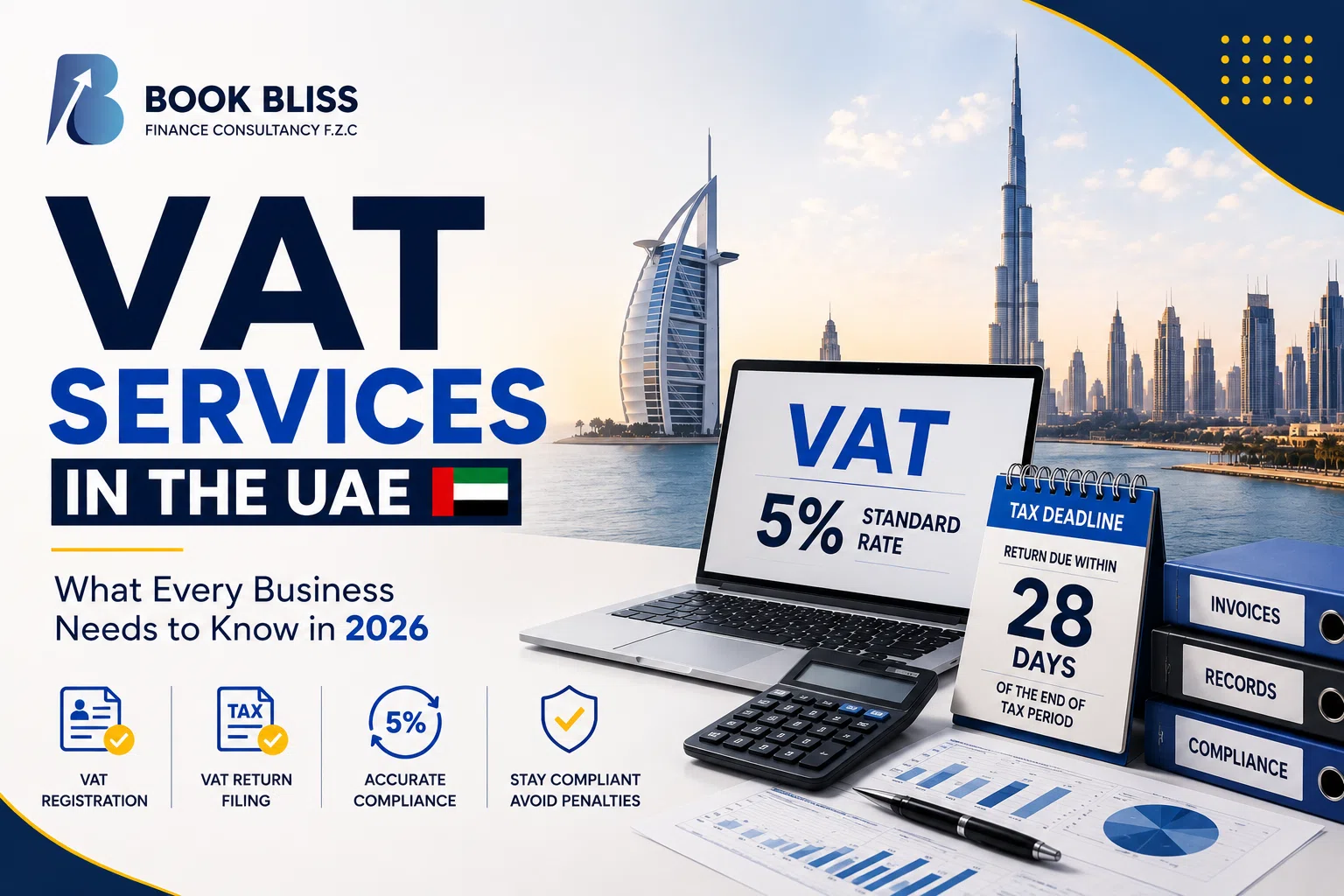
Value Added Tax has applied in the UAE since 1 January 2018, at a standard rate of 5% — unchanged since introduction, and applied uniformly across all seven emirates. It’s administered entirely by the Federal Tax Authority (FTA) through the EmaraTax portal, which handles registration, filing, payment, and every other VAT interaction a business will have.
The 5% rate sounds simple, but VAT compliance isn’t really about the rate — it’s about the ongoing administrative discipline of registering correctly, filing on time, reclaiming input tax accurately, and keeping records that hold up if the FTA ever asks questions. That ongoing discipline is what “VAT services” actually means in practice, and it breaks down into several distinct areas that businesses often assume are one single task.
Who Actually Needs to Register
VAT registration in the UAE isn’t optional once a business crosses a specific line, and there’s no exception based on company type, ownership nationality, or which emirate the business operates in.
Mandatory registration applies once a business’s taxable supplies and imports exceed AED 375,000 over any rolling 12-month period — not a calendar year, a rolling window, which catches out businesses that only check their revenue once a year. Once that threshold is crossed, the business has 30 days to submit its registration application.
Voluntary registration is available from AED 187,500 — half the mandatory threshold. Many smaller or newer businesses register voluntarily specifically to reclaim input VAT on startup costs, even before they’re required to.
Missing the mandatory window is genuinely expensive. Under current FTA rules, late registration carries a fixed AED 10,000 penalty, and it also triggers retroactive VAT liability — meaning the business owes VAT on all taxable supplies made from the date it should have registered, not just from whenever it actually does.
VAT Registration: What the Process Actually Involves
Registration happens entirely through EmaraTax, and while the portal itself is straightforward, the substance of the application is where businesses commonly stumble:
- Determine your registration category — standalone taxable person, or part of a VAT group (if commonly controlled entities want to file as one unit).
- Gather supporting documents — trade licence, Emirates ID/passport of owners, financial statements or projected revenue for new businesses, and bank account details.
- Complete the application accurately, including projected or historical taxable supplies — inaccuracies here can delay approval or trigger follow-up queries from the FTA.
- Receive your Tax Registration Number (TRN) once approved, typically within a matter of days if the application is complete and accurate.
- Understand your filing frequency immediately upon registration — most businesses file quarterly, though larger businesses may be assigned monthly filing.
A registration application that’s rushed or filled in with rough estimates rather than real figures is one of the more common sources of delay — the FTA will query numbers that look inconsistent with the business’s actual activity, adding weeks to a process that should take days.
VAT Return Filing: The Recurring Obligation
Once registered, VAT returns are due within 28 days of the end of each tax period — quarterly for most businesses, monthly for larger ones as assigned by the FTA. This isn’t a one-time task; it’s a recurring cycle that continues for as long as the business remains registered.
Filing late carries an immediate, fixed penalty: AED 1,000 for a first late return, rising to AED 2,000 for any repeat within a 24-month window — and these apply per return, meaning a business that misses two consecutive quarters accumulates two separate penalties, not one.
Filing on time but paying late is a separate problem. As of Cabinet Decision No. 129 of 2025, effective 14 April 2026, the UAE moved to a simplified interest-based late payment structure: unpaid VAT now accrues interest at a flat 14% per annum, calculated monthly, rather than the older compounding percentage structure. This is actually a meaningful improvement for businesses that pay late but not extremely late — under the old rules (2% immediate penalty, then 4% per month, capped at 300%), a modest delay could snowball fast. Under the current rules, the cost is more predictable, though still real.
Filing correctly matters as much as filing on time. An error in a submitted return, even one filed on schedule, can carry its own AED 500 penalty under current rules — though no penalty applies if the error is corrected before the filing deadline, or through a voluntary disclosure that results in no additional tax owed.
VAT Accounting: Where Bookkeeping and Tax Meet
VAT isn’t a separate ledger from your regular accounting — it has to be integrated into daily bookkeeping, not reconciled as an afterthought once a filing deadline approaches. Every taxable transaction needs to be correctly classified as standard-rated, zero-rated, or exempt at the moment it’s recorded, because reconstructing that classification months later, across a full quarter of transactions, is where most VAT accounting errors actually originate.
This is also where input tax recovery lives — the VAT a business pays on its own purchases and expenses, which can be reclaimed against VAT collected on sales. Missing legitimate input tax recovery is a quiet, ongoing cost: it doesn’t trigger a penalty, but it means a business is simply paying more net VAT than it needs to, quarter after quarter, without ever realizing it.
VAT Consultancy: Where the Real Judgment Calls Live
Registration and filing are largely procedural once you know the steps. VAT consultancy is where the genuinely complex questions get resolved — the ones that don’t have a single obvious answer in the law itself:
- How should a mixed-use transaction (partly taxable, partly exempt) be treated?
- Does a specific supply qualify for zero-rating, or does it not quite meet the conditions?
- How should a business operating across a free zone and the mainland structure its VAT treatment?
- What’s the correct treatment for a transaction involving related parties, or an unusual one-off deal outside the business’s normal activity?
These aren’t questions with a lookup-table answer — they require someone who understands both the letter of UAE VAT law and how the FTA actually applies it in practice. Getting one of these wrong doesn’t always surface immediately; it can sit quietly in a business’s VAT position for months or years until an audit brings it to the surface, at which point correcting it retroactively is far more expensive than getting it right the first time.
VAT Deregistration: The Step Businesses Forget
Deregistration matters just as much as registration, and it’s the step most commonly overlooked. A business needs to deregister when its taxable supplies fall below the voluntary threshold (AED 187,500) for 12 consecutive months, or when it ceases making taxable supplies entirely — closing down, restructuring, or changing its core activity.
Failing to deregister when required doesn’t just create administrative clutter — it means continuing to carry live VAT obligations (filing, payment) for a business that may no longer have the activity or cash flow to support them. And deregistration itself has a process: outstanding returns must be filed and settled before the FTA will process it, so a business that’s fallen behind on filing can’t simply exit the system to stop the obligations from accumulating.
Free Zone VAT: A Layer of Extra Complexity
VAT treatment for free zone businesses isn’t uniform across all free zones. The UAE distinguishes specific Designated Zones — a defined list of free zones treated, for certain VAT purposes, as outside the UAE for the movement of goods between them. Being located in a free zone doesn’t automatically mean VAT-exempt status, and businesses frequently misunderstand this distinction, assuming free zone location alone changes their VAT position when it often doesn’t for services, and only applies in specific circumstances for goods within Designated Zones specifically.
Getting this wrong is a recurring VAT consultancy conversation — free zone businesses in particular benefit from a direct review of exactly how their specific zone and specific activity are treated, rather than assuming a general rule applies.
VAT vs. Excise Tax: A Common Point of Confusion
Excise tax is a separate tax entirely from VAT, applied to specific goods considered harmful to health or the environment — tobacco products, energy drinks, carbonated drinks, and similar categories — at rates that can run considerably higher than the 5% VAT rate. A business dealing in any excise goods needs excise tax registration and reporting on top of, not instead of, its VAT obligations. These are commonly confused because both are administered by the same authority through the same EmaraTax portal, but they’re governed by different laws, different rates, and different registration triggers.
Common VAT Mistakes That Cost UAE Businesses Money
A handful of patterns show up repeatedly, across businesses of every size:
Registering late because revenue is only checked annually. The 375,000 threshold is a rolling 12-month figure, not a calendar-year one — a business can cross it mid-year without anyone noticing until it’s already overdue.
Treating VAT accounting as a quarterly task instead of a daily habit. Reconstructing three months of transaction classification right before a filing deadline is where errors creep in.
Missing input tax recovery on legitimate business expenses. This one is invisible — no penalty, just quietly overpaying VAT every quarter.
Assuming free zone status changes VAT treatment automatically. It often doesn’t, and assuming otherwise can mean under-collecting VAT that’s actually due.
Forgetting to deregister when a business winds down or drops below threshold, leaving live obligations running for a business that’s no longer actively operating in the same way.
Filing on time but not verifying accuracy, assuming that meeting the deadline is the same as filing correctly — it isn’t, and the two carry separate risks.
How to Choose a VAT Services Provider
A few things genuinely matter more than others when evaluating who handles this for your business:
- FTA-recognized status. A provider who can point to their own registered tax agent credentials is demonstrating direct accountability to the same authority your business answers to.
- Integration between bookkeeping and VAT, not two disconnected services run by different teams that only reconcile at filing time.
- A track record with your specific situation — free zone, mainland, multi-emirate, or industry-specific VAT treatment, since generic VAT knowledge doesn’t always cover the nuance your business actually needs.
- Proactive communication about deadlines, not just reactive filing once a deadline is already close.
Get Your VAT Position Reviewed
Whether you’re registering for the first time, unsure if your current filing is fully accurate, sitting on unclaimed input tax, or approaching a point where deregistration might apply, a direct review of your VAT position is worth more than guessing.
Book Bliss provides VAT registration, return filing, VAT-integrated accounting, consultancy, and deregistration services for businesses across the UAE. If any part of your VAT position feels uncertain, get in touch for a free consultation.
This article is general information current as of publication and isn’t a substitute for personalized tax advice. VAT rules, thresholds, and penalties are set by the Federal Tax Authority and can change — confirm your specific situation with a qualified advisor.
Frequently Asked Questions
What is the VAT registration threshold in the UAE?
Mandatory registration applies once taxable supplies exceed AED 375,000 over any rolling 12-month period. Voluntary registration is available from AED 187,500.
What happens if I register for VAT late?
Late registration carries a fixed AED 10,000 penalty, and also triggers retroactive VAT liability on all taxable supplies made from the date the business should have registered.
How often do I need to file VAT returns?
Most businesses file quarterly, though the FTA may assign monthly filing to larger businesses. Returns are due within 28 days of the end of each tax period.
What’s the penalty for late VAT payment in 2026?
As of Cabinet Decision No. 129 of 2025, effective 14 April 2026, late payment accrues interest at a flat 14% per annum, calculated monthly, replacing the older compounding percentage structure.
Does being in a free zone mean I don’t have to pay VAT?
Not automatically. Only specific Designated Zones receive special VAT treatment, and even then only for certain transactions involving goods, not universally for all business activity. Free zone status alone doesn’t exempt a business from VAT.
When do I need to deregister for VAT?
Deregistration is required if taxable supplies fall below AED 187,500 for 12 consecutive months, or if the business stops making taxable supplies entirely. Outstanding returns must be filed and settled before deregistration can be processed.