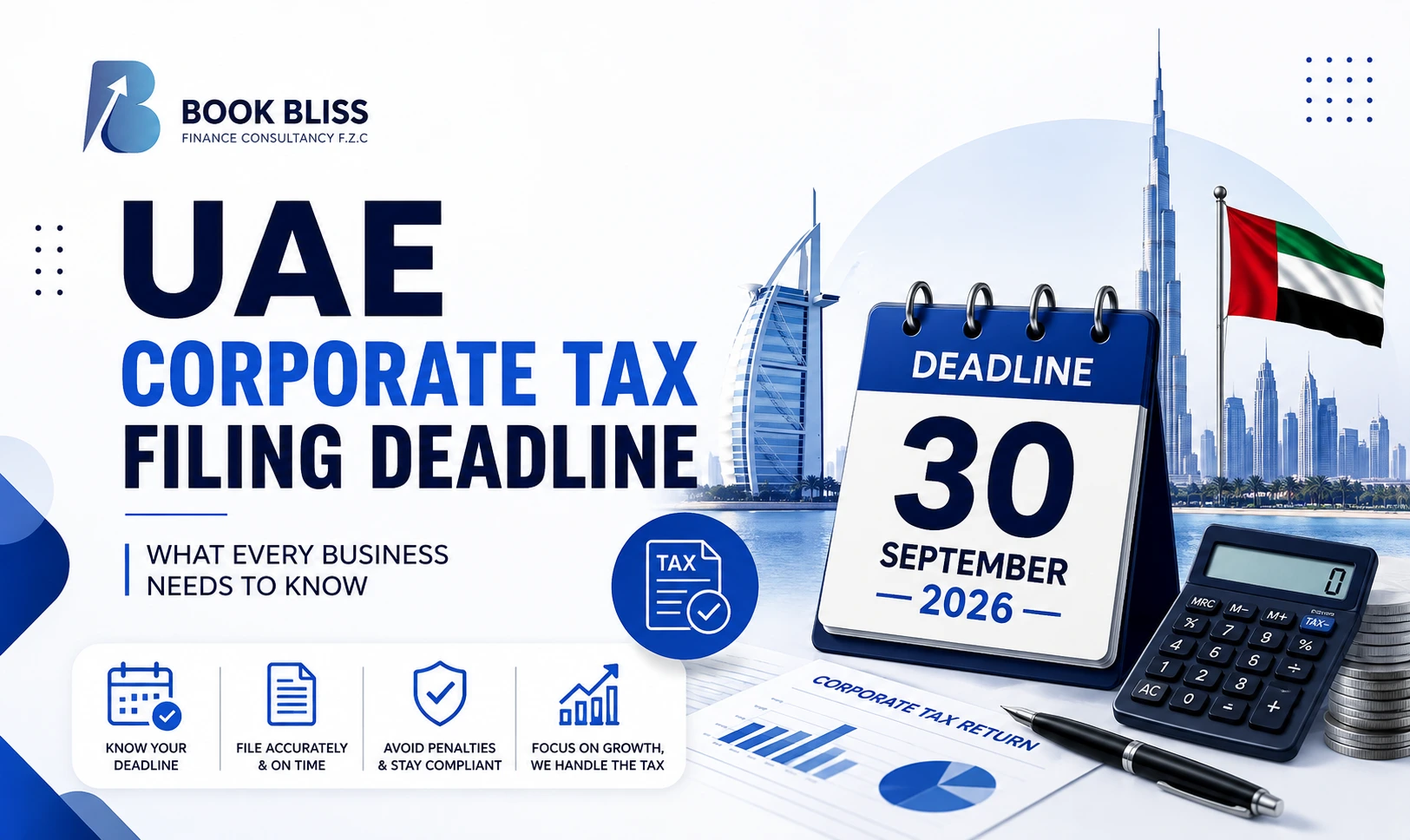
If your business has a financial year ending 31 December 2025, your corporate tax return is due by 30 September 2026 — and it’s closer than it might feel. Whether you haven’t registered yet, aren’t sure how the deadline applies to your specific business, or want to understand the penalties before they become a problem, this guide walks through everything relevant, in the order you’ll actually need it.
UAE Corporate Tax Filing Deadline 2026
When Is Your Deadline, Exactly?
The UAE’s corporate tax rule is simple once you know it: every business must file its return within nine months of its financial year-end. The confusion usually comes from assuming everyone shares the same date — they don’t, and this is the single most common point of confusion businesses run into.
Here’s how it plays out for different year-ends:
| Financial year ends | Filing deadline |
|---|---|
| 31 December 2025 | 30 September 2026 |
| 31 January 2026 | 31 October 2026 |
| 31 March 2026 | 31 December 2026 |
| 30 June 2026 | 31 March 2027 |
Most UAE businesses operate on a calendar year, which is why 30 September gets discussed the most — but it isn’t universal. If you’re not certain which date applies to your business, that’s worth confirming before anything else in this article.
One detail that regularly catches businesses off guard: the deadline is tied to your financial year-end, not your registration date or trade licence renewal date. Getting registered and receiving your Corporate Tax Registration Number (TRN) doesn’t reset the clock. The nine-month rule runs from your fiscal year-end regardless of when you registered, when your licence renews, or when you first started thinking about compliance. A business that registered late still has the same filing deadline as one that registered on day one — registering late doesn’t buy extra time, it just means less runway before the deadline arrives.
Do You Need to File Even If You Owe Zero Tax?
Yes — and this is one of the most common and costly misconceptions among small business owners. Filing is required even if:
- Your taxable income falls below the AED 375,000 threshold
- You’ve elected for Small Business Relief and expect a zero-tax outcome
- Your business recorded a loss for the period
- You’re a free zone business benefiting from the 0% qualifying income rate
Filing and paying are two separate obligations that happen to share a deadline. Even when nothing is owed, the return itself still has to be submitted. Skipping it because “there’s no tax to pay anyway” is a mistake that still carries a penalty — the FTA doesn’t distinguish between “didn’t file because nothing was owed” and “didn’t file, period.” Both are simply non-compliance, treated identically for penalty purposes.
Understanding Small Business Relief and How It Affects Your Filing
If your business has revenue of AED 3 million or less, you may be eligible to elect for Small Business Relief, which allows you to be treated as having no taxable income for the period — effectively a 0% outcome. A few things worth understanding clearly:
It’s an election, not an automatic outcome. Being under the revenue threshold doesn’t apply the relief by itself. You still have to actively elect for it as part of your return, and you still have to file that return by the same deadline as everyone else. Businesses sometimes assume qualifying automatically means the relief is applied — it isn’t, and missing the election means missing the benefit entirely, even if you technically qualified.
The relief has a shelf life. It’s currently available for tax periods ending on or before 31 December 2026. Businesses relying on it now should be thinking ahead to what changes from 2027 onward, when standard treatment applies to income above AED 375,000. This year’s filing may be the last time some businesses see the full benefit of this relief, which makes getting the election right this cycle more important than it might have seemed in previous years.
Eligibility depends on more than revenue. Certain business structures and activities may be excluded from the relief regardless of how much revenue the business generates, so it’s worth confirming eligibility with an advisor rather than assuming it based on the revenue figure alone.
Businesses that qualify for Small Business Relief sometimes assume the “zero tax” outcome means the filing itself is a formality that can wait. It isn’t, and it can’t. The return is still due on the same nine-month clock as every other business, relief or not.
How to Register for Corporate Tax in the UAE
If you haven’t registered yet, here’s the process at a glance:
- Create or access your account on the EmaraTax portal, the Federal Tax Authority’s official platform for corporate tax and VAT administration. If you’re already registered for VAT, you may be able to use the same portal login rather than starting from scratch.
- Submit your business details, including trade licence information, business activity classification, and ownership structure. Accuracy matters here — errors at this stage tend to resurface later during the actual return filing, sometimes in ways that are harder to correct after the fact.
- Receive your Corporate Tax Registration Number (TRN) once your application is approved. This is distinct from any VAT TRN you may already hold; corporate tax registration is its own separate process with its own number.
- Prepare your financial records — audited financial statements where required, trial balances, and the supporting schedules your tax computation depends on. This is usually the step that takes the longest, particularly for a business’s first filing, since it often surfaces gaps in bookkeeping that weren’t obvious until someone needed to compile a full year’s financial picture at once.
- File your return through EmaraTax before your deadline, with digital signatures and payment integration handled directly on the portal, including confirmation receipts once submission is complete.
Registration deadlines themselves are separate from filing deadlines and are generally tied to your trade licence issuance date, following a schedule the FTA has published for different entity types. If you’re unsure whether you’ve already missed a registration window, that’s worth checking urgently — registration penalties accrue independently of filing penalties, meaning a business can be penalized for late registration even before the filing deadline itself arrives.
Financial Statements and Audit Requirements
A step many businesses underestimate is how much of the filing process depends on financial statements being genuinely ready, not just roughly assembled.
Audited financial statements are generally required for certain categories of businesses, particularly those above specified revenue thresholds or with more complex structures. Smaller businesses may be able to rely on unaudited financial statements, but the underlying bookkeeping still needs to be accurate and complete enough to support the tax computation being submitted.
Your accounting figures and your tax figures are not automatically the same thing. This surprises many businesses filing for the first time. Some expenses that are legitimate and deductible under standard accounting practice are not deductible for corporate tax purposes, and some income that appears in your accounting records may be treated differently for tax purposes — particularly around exempt income categories. This means a business can’t simply take its accounting profit and submit it as taxable income; a proper reconciliation between the two is a required part of the process, not an optional refinement.
Depreciation is a common area of mismatch. Accounting depreciation schedules and tax depreciation rules don’t always align, and treating them as interchangeable is one of the more common technical errors in first-time filings.
Related-party transactions need separate disclosure. If your business has dealings with related entities — common in group structures or businesses with multiple related companies — these transactions typically require their own disclosure and, in some cases, transfer pricing documentation demonstrating that the transactions were conducted on arm’s-length terms, meaning terms comparable to what unrelated parties would have agreed to.
What Actually Goes Into a Corporate Tax Return
For businesses filing for the first time, it helps to understand what the return actually contains, beyond just “your income and expenses.”
At a minimum, a corporate tax return generally needs to reflect:
- Total revenue and taxable income for the period, reconciled from your accounting records
- Disallowed expenses — costs that were legitimate business expenses under accounting rules but aren’t deductible for tax purposes
- Exempt income, clearly separated and justified, since not all income is treated as taxable
- Applicable reliefs or elections, such as Small Business Relief, properly claimed rather than assumed
- Related-party transaction disclosures, where applicable
- Final tax calculation, applying the correct rate to the correct taxable income figure after all adjustments
None of this is inherently complicated in isolation, but for a business handling it for the first time, the number of small technical distinctions — what’s deductible versus what isn’t, what’s exempt versus what isn’t — is where most of the real work sits. This is also where the case for getting help before filing, rather than after, is strongest: these distinctions are far easier to get right on the first pass than to correct after submission.
Common Mistakes in First-Time Filings
A handful of mistakes show up repeatedly among businesses filing for the first time, and most of them are avoidable with a bit of forward planning:
Assuming zero tax means no filing obligation. Covered above, but worth repeating because it’s genuinely the most common misconception and one of the costliest, since it turns a simple filing into a late-filing penalty for no financial benefit at all.
Treating accounting profit as taxable income without reconciliation. As discussed, these figures diverge, sometimes significantly, and submitting unreconciled accounting profit as if it were the tax computation is a frequent and consequential error.
Missing the Small Business Relief election despite qualifying for it. Eligibility isn’t the same as automatic application — the election has to actually be made.
Underestimating how long financial statement preparation takes. Businesses that start pulling records together in the final week before the deadline routinely discover gaps, missing documentation, or reconciliation issues that need more time than remains.
Misclassifying free zone income as automatically exempt. Free zone status doesn’t mean every dollar of income qualifies for the 0% rate — qualifying income has specific conditions attached, and assuming all free zone income qualifies without checking is a common and costly error.
Forgetting related-party disclosures entirely, particularly among businesses that don’t think of their group structure as involving “related parties” in the way the tax rules define the term.
What Happens If You Miss the Deadline
The penalty structure is designed to compound, not stay flat, the longer a business remains non-compliant:
Late filing penalty: a fixed monthly penalty applies for each month, or part of a month, the return remains unfiled, with the amount typically increasing the longer the delay continues rather than staying constant.
Interest on unpaid tax: charged at 14% per annum, calculated daily from the day after the payment deadline until the tax is fully settled, with no upper limit on how much this can accumulate over time. This is separate from the late filing penalty, not an alternative to it.
These run in parallel. A business that’s both late to register and late to file can face penalties in multiple categories simultaneously, with no single cap limiting the combined total. This is the detail that surprises people most — there isn’t one penalty to budget for, there are potentially several, stacking on top of each other the longer non-compliance continues.
Voluntary Disclosure: What to Do If You’ve Already Made an Error
If you’ve already made an error rather than missed the deadline entirely, the UAE’s voluntary disclosure process offers a meaningfully better outcome than waiting to be caught.
Correcting an error proactively — before the FTA identifies it independently — carries a smaller penalty, calculated monthly on the tax difference involved. If the same error is instead identified after an FTA audit notification has already been issued, the penalty increases substantially, with an additional percentage added on top of the base penalty.
Voluntary disclosures generally need to be submitted within 20 business days of identifying the error. This is a tight window, which means the moment a mistake is spotted — whether during a routine review or while preparing the following year’s filing — is the moment to act, not something to schedule for later.
A Note on Free Zone Businesses
Free zone companies occupy a specific position in the UAE corporate tax system worth addressing directly, since the rules here are a frequent source of confusion.
Being registered in a free zone does not exempt a business from corporate tax filing. Free zone businesses that qualify for the 0% rate on qualifying income are still required to register for corporate tax and file annual returns — the 0% rate is a rate applied within the filing, not an exemption from the filing obligation itself.
What counts as “qualifying income” is defined specifically, and income falling outside that definition may be taxed at the standard rate even for an otherwise qualifying free zone business. This means a free zone business can have some income taxed at 0% and other income taxed at the standard rate within the same return, depending on how each income stream is classified. Treating all free zone income as uniformly tax-free without this classification step is one of the more consequential mistakes free zone businesses make.
Record-Keeping Requirements
Beyond the filing itself, UAE corporate tax rules require businesses to maintain supporting records for a specified retention period, generally cited as at least seven years. This isn’t just good practice — it’s a compliance requirement in its own right, and the FTA can request supporting documentation well after a return has been filed and accepted.
Practically, this means the financial statements, computations, and supporting schedules prepared for this year’s filing shouldn’t be treated as disposable once submitted. They need to be retained, organized, and retrievable for years afterward, in case of a future audit or review request.
Why It’s Worth Filing Early, Not on the Deadline Itself
The Federal Tax Authority has directly encouraged businesses to file as early as possible rather than waiting until the final days, and there’s a practical reason beyond general compliance culture. Late-stage filing means competing with every other business trying to submit in the same final week, which increases the chance of payment processing delays through UAE banking channels, portal slowdowns during peak submission periods, or last-minute document issues that leave no time to correct before the deadline passes.
Filing even a week or two ahead of 30 September removes that risk entirely, and it also leaves a buffer for the unexpected — a missing document, a reconciliation question, a portal issue — without that buffer eating into the deadline itself.
A Pre-Filing Checklist
Before you file, it’s worth confirming each of the following:
- You know your exact financial year-end and the specific deadline it produces for your business
- Your Corporate Tax Registration Number (TRN) is active and confirmed
- Audited financial statements, or equivalent records where audits don’t apply, are finalized
- Taxable income has been calculated, with disallowed expenses properly separated from deductible ones
- Any applicable relief, such as Small Business Relief, has been actively elected, not just assumed based on eligibility
- Related-party transactions, if applicable, are disclosed with appropriate supporting documentation
- Free zone qualifying income, if applicable, has been correctly classified rather than assumed
- Supporting documents are ready to upload to EmaraTax in the required formats
- Records are organized for long-term retention, not just for this year’s submission
Get Help Before the Deadline, Not After
Corporate tax is still relatively new territory for most UAE businesses — for many, this will be their first or second filing ever, and the number of technical distinctions involved (deductible versus non-deductible expenses, qualifying versus non-qualifying free zone income, proper relief elections) is genuinely easy to get wrong without experience handling them before.
A short review with an advisor before you submit can catch registration issues, confirm relief eligibility, correctly classify free zone income, and make sure your financial statements translate accurately into your tax computation — before an error becomes a penalty, or a missed election becomes a missed benefit.
Book Bliss helps UAE businesses register, prepare, and file their corporate tax returns correctly and on time. If your deadline is approaching and you want a second set of eyes before you submit, or you haven’t started yet and aren’t sure where to begin, get in touch for a free consultation.
This article is general information current as of publication and isn’t a substitute for personalized tax advice. Confirm your specific filing deadline and obligations with a qualified advisor or directly with the Federal Tax Authority.
Frequently Asked Questions
What is the UAE corporate tax deadline for 2026?
For businesses with a financial year ending 31 December 2025, the deadline is 30 September 2026. Businesses with different financial year-ends have different deadlines, calculated as nine months after their specific year-end date.
Do free zone businesses need to file a corporate tax return?
Yes. Even free zone businesses benefiting from the 0% rate on qualifying income are still required to register and file a return. The 0% rate doesn’t exempt a business from the filing obligation, and not all free zone income automatically qualifies for that rate.
What’s the penalty for filing corporate tax late in the UAE?
A monthly late filing penalty applies for each month the return remains outstanding, along with 14% annual interest on any unpaid tax, calculated daily with no cap. Both can apply at the same time, and registration penalties can apply separately as well.
Can I still register for corporate tax if I’ve missed my registration deadline?
Yes, but the longer registration is delayed, the more penalty exposure accumulates. It’s worth registering as soon as possible and addressing any resulting penalties directly rather than continuing to delay.
What is voluntary disclosure and when should I use it?
Voluntary disclosure is the process of proactively correcting an error in a previously filed return. It generally needs to be submitted within 20 business days of identifying the error, and it carries a smaller penalty than having the same error found later during an FTA audit.
Is my accounting profit the same as my taxable income?
No. Certain expenses that are deductible for accounting purposes aren’t deductible for tax purposes, and some income may be treated differently for tax purposes than it is in standard accounting records. A reconciliation between the two is a required part of preparing the return, not an optional step.