Outsourced Bookkeeping & Bank Reconciliation Services in the UAE
Bookkeeping is the part of running a business that everyone agrees matters and almost no one wants to do consistently. It’s rarely urgent on any single day — until the day it suddenly is, usually right before a VAT filing, a corporate tax deadline, or a bank asking for financial statements you can’t quite produce with confidence. This guide covers what outsourced bookkeeping actually involves in the UAE, why bank reconciliation specifically tends to fall behind, what to do if your books are already behind, and how bookkeeping connects to the VAT and payroll obligations most UAE businesses are also juggling.
What Outsourced Bookkeeping Actually Covers
Outsourced bookkeeping isn’t a single task — it’s the ongoing management of a business’s financial records, handled by someone outside the company rather than an in-house hire. For most small and mid-sized UAE businesses, this covers:
- Daily transaction recording — sales, purchases, expenses, and bank activity entered accurately and on schedule, not in a monthly catch-up session
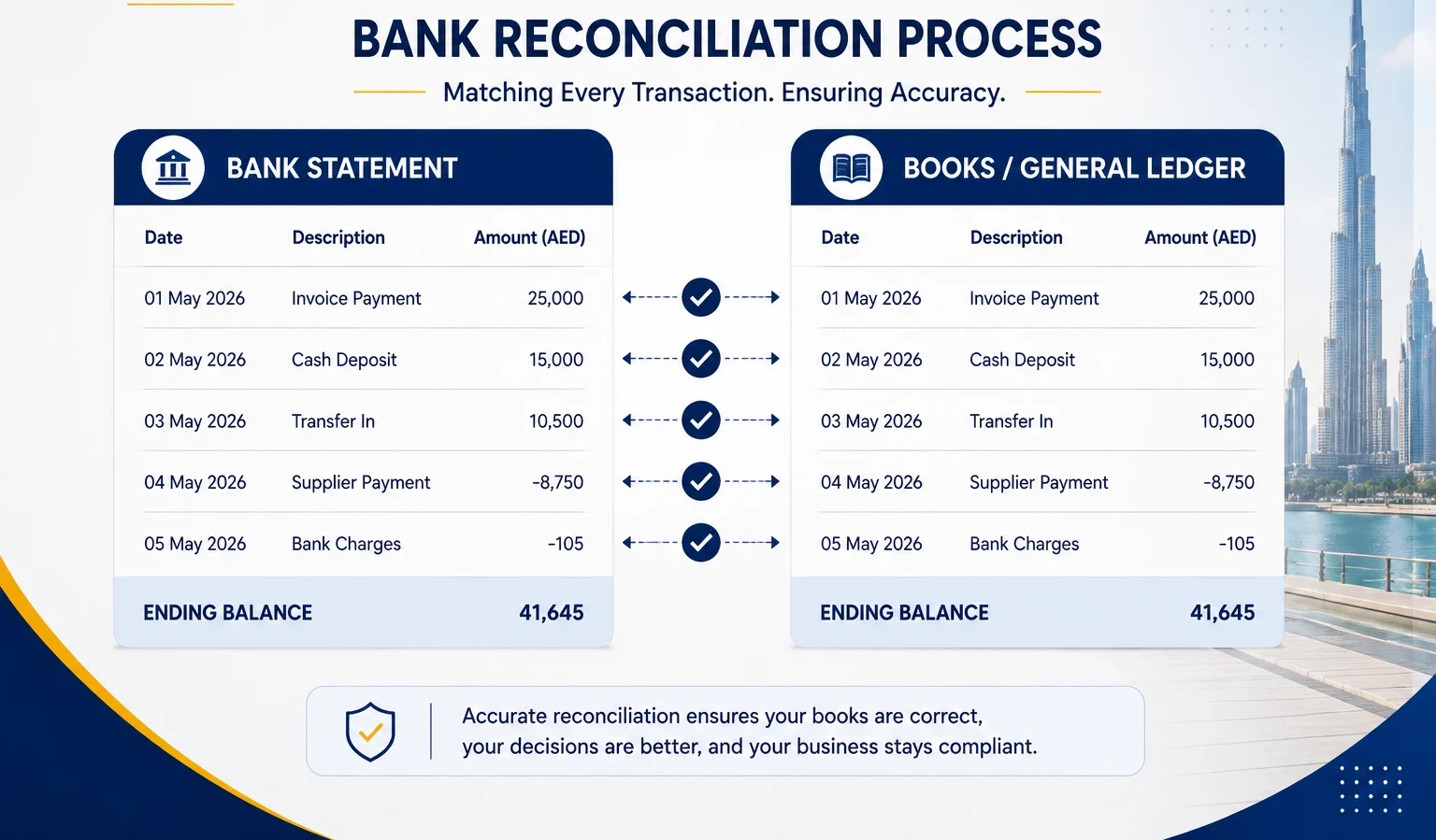
- Bank and account reconciliation — confirming that what your books say matches what your bank and other records actually show
- Accounts receivable and payable tracking — knowing who owes you money, who you owe, and when
- Monthly financial reporting — turning raw transaction data into something you can actually use to make decisions
- VAT-ready record keeping — books organized in a way that makes quarterly VAT filing straightforward rather than a scramble
The appeal of outsourcing this rather than hiring in-house is straightforward: a full-time bookkeeper is a fixed cost regardless of how much transaction volume you actually have in a given month, while outsourcing scales with your business and typically costs less than a full-time salary, benefits, and the management overhead of a direct hire. For a full breakdown of what an outsourced engagement includes, Book Bliss’s outsourced accounting service covers the complete scope.
Bank & Account Reconciliation: Why It’s the Most Commonly Neglected Task
If there’s one bookkeeping task that quietly falls behind more than any other, it’s reconciliation. It’s not glamorous, it doesn’t feel urgent day-to-day, and unlike an unpaid invoice, nobody calls to remind you it’s overdue.
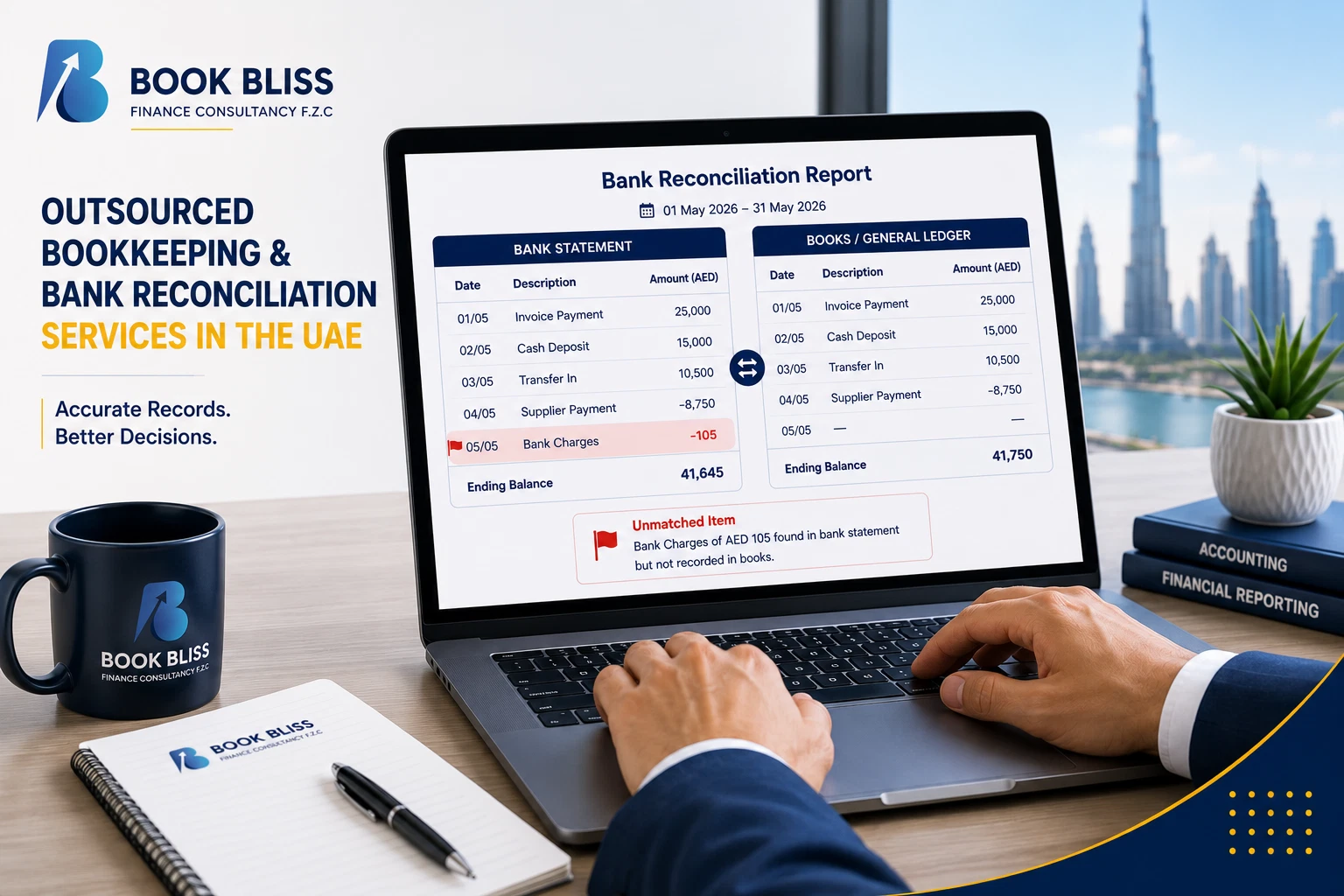
What reconciliation actually is: comparing your internal accounting records against an independent source — most commonly your bank statement — to confirm they match. When they don’t match, that gap needs to be investigated and explained, not just adjusted away.
Why it gets skipped: reconciliation is often treated as a once-a-quarter or once-a-year task, done right before a filing deadline rather than monthly. The problem compounds the longer it’s deferred — a single month of unreconciled transactions is a manageable review; a full year is a genuine project, often turning up:
- Duplicate entries that inflated reported revenue or expenses
- Bank fees or charges that were never recorded
- Payments that cleared the bank but were never entered into the books, or vice versa
- Timing differences that look like errors but are actually just transactions recorded in different periods
Monthly reconciliation, done consistently, turns this from a periodic crisis into a five-minute review. This is true whether you’re reconciling a single UAE bank account or several — multi-account businesses in particular benefit from reconciling each account on its own schedule rather than attempting a single year-end catch-up across all of them at once. For UAE businesses specifically managing this across Dubai-based accounts, Abu Dhabi accounts, or multiple emirates, Book Bliss’s account reconciliation service handles this on a recurring monthly basis rather than a reactive one.
Behind on Your Books? Catching Up Backlog Accounts
If reconciliation has been skipped for months rather than caught monthly, you’re not alone — this is one of the most common situations UAE businesses reach out about, and it’s genuinely fixable, just not instantly.
What backlog bookkeeping catch-up actually involves:
- Gathering the full period’s source documents — bank statements, invoices, receipts, and any existing partial records for the period that needs catching up
- Reconstructing the transaction history — entering everything that should have been recorded month-by-month, in the correct periods, not as a single lump-sum adjustment
- Reconciling each period as it’s rebuilt — catching errors as they’re found, rather than compounding them forward
- Producing accurate, current financial statements once the backlog is cleared — the actual point of the exercise
Why this can’t be rushed, even under deadline pressure: a business facing a VAT filing or corporate tax deadline with months of backlog often wants this done as fast as possible, understandably. But reconstructing a full year of transactions accurately takes real time — attempting to compress this into a few days usually means trading accuracy for speed, which creates exactly the kind of errors that cause problems later during a filing or an audit.
A note specific to businesses in Abu Dhabi and across the wider UAE: backlog catch-up isn’t just a Dubai-specific need — it’s common across every emirate, and the process doesn’t change based on location, only based on how far behind the books actually are. Book Bliss’s backlog accounting service handles this reconstruction process for UAE businesses regardless of how many months or years need to be caught up.
Accounting System Analysis, Setup & Training
A recurring reason bookkeeping falls behind isn’t a lack of effort — it’s a system that was never properly set up in the first place, or one that’s grown unwieldy as the business grew without anyone revisiting how it’s structured.
Accounting system analysis looks at how a business’s current accounting software and processes are actually being used — not just whether the software is “good,” but whether the chart of accounts is structured sensibly, whether the same transaction types are being categorized consistently, and whether the system is actually producing usable reports or just accumulating data nobody reviews.
Common findings during a system analysis:
- An overgrown or inconsistent chart of accounts, where the same type of expense has been recorded under three different categories over time, making reports genuinely misleading
- Manual processes that could be automated, particularly around bank feed imports and recurring transactions
- A system that was set up for a much smaller business and never restructured as transaction volume or complexity grew
- No clear separation between VAT-relevant categorization and general expense tracking, which makes quarterly VAT prep harder than it needs to be
Setup and training follows naturally from this: getting the system structured correctly from the start, and making sure whoever handles day-to-day entry — whether that’s internal staff or an outsourced team — actually understands how to use it consistently. A well-set-up system with basic training behind it prevents most of the reconciliation headaches described above before they start. Book Bliss’s system analysis service covers this review and setup process directly.
Bookkeeping for VAT-Registered Businesses: What’s Different
Once a business is VAT-registered in the UAE, bookkeeping stops being purely an internal management tool and becomes something the Federal Tax Authority can directly scrutinize. This changes what “good enough” bookkeeping looks like.
For a VAT-registered business, books need to:
- Classify every transaction correctly as standard-rated, zero-rated, or exempt at the point of entry — not reconstructed later from memory
- Track input VAT on purchases and expenses accurately, so it can be properly reclaimed rather than lost through poor record-keeping
- Reconcile cleanly against VAT return figures, since a mismatch between your bookkeeping records and what’s been filed is one of the more common triggers for FTA scrutiny
- Retain supporting documentation in a form that can actually be produced if requested, not scattered across email threads and personal drives
This is also where reconciliation and VAT compliance intersect directly: a business that reconciles monthly and classifies transactions correctly as it goes will find quarterly VAT filing straightforward. A business that reconstructs everything right before the filing deadline is far more likely to misclassify transactions under time pressure. For the full VAT compliance picture, Book Bliss’s VAT accounting service integrates directly with ongoing bookkeeping rather than treating VAT as a separate, disconnected task.
Payroll Bookkeeping: Where Payroll and Accounting Meet
Payroll isn’t just a monthly disbursement — it has its own accounting implications that need to flow correctly into the broader bookkeeping picture: salary expenses, statutory contributions, end-of-service liabilities accruing over time, and any benefits or allowances that carry their own accounting treatment.
A common gap: payroll gets processed correctly and on time, but the accounting entries behind it are either delayed, oversimplified, or not properly reconciled against what was actually paid. Over time, this creates a quiet mismatch between payroll records and the general ledger — usually only discovered during a year-end review or an audit, at which point untangling months of discrepancy is far more work than recording it correctly each month would have been.
Integrating payroll bookkeeping into the same monthly cycle as general reconciliation avoids this entirely. Book Bliss’s payroll accounting service handles this integration directly, rather than treating payroll as a separate process that only touches the books once a year.
Part-Time vs. Full Outsourced Bookkeeping: Which Fits Your Business
Not every business needs the same level of bookkeeping support, and matching the service to actual transaction volume matters both for cost and for quality.
Part-time bookkeeping tends to suit smaller businesses with lower transaction volume — enough activity that DIY bookkeeping becomes a real time drain, but not enough to justify a full-time equivalent resource. This typically covers regular reconciliation and record-keeping on a lighter, scheduled cadence.
Full outsourced accounting fits businesses with higher transaction volume, multiple revenue streams, or more complex reporting needs — where monthly (or more frequent) attention is genuinely required to keep the books current and reconciled.
Getting this match wrong in either direction causes problems: too little support for a genuinely complex business means backlog builds regardless of intentions; too much support for a simple business means paying for capacity that isn’t being used. Book Bliss’s part-time accounting service is scaled specifically for businesses in the lighter-volume category, without forcing a full-service commitment that isn’t needed yet.
Common Bookkeeping Mistakes UAE Businesses Make
A handful of patterns show up repeatedly, across businesses of every size:
Treating reconciliation as an annual task instead of a monthly one. Covered above, but worth restating — this single habit change prevents most of the backlog situations this article addresses.
Recording transactions without proper VAT classification from the start. Reclassifying months of transactions after the fact is slow and error-prone compared to classifying correctly at entry.
Letting payroll and general bookkeeping drift apart. Two systems that should tell the same story quietly diverging over time.
Outgrowing an accounting system’s original setup without revisiting it. A chart of accounts built for a small, simple business doesn’t automatically scale cleanly as the business grows more complex.
Assuming backlog catch-up can be compressed under deadline pressure. It can be done faster with focused resources, but accuracy still requires real time — rushing it usually just relocates the errors rather than eliminating them.
How to Choose an Outsourced Bookkeeping Partner
A few things genuinely matter more than others when evaluating who handles this for your business:
- Monthly reconciliation as standard practice, not an occasional catch-up service
- Direct integration between bookkeeping and VAT compliance, rather than two disconnected processes that only meet at filing time
- Experience specifically with UAE requirements — free zone vs. mainland distinctions, FTA expectations, and local banking reconciliation practices
- Clear, regular reporting you can actually read and use, not just raw data delivered without context
Get Your Books Genuinely Current
Whether your bookkeeping needs a monthly reconciliation partner, a backlog catch-up project, a system that’s never been properly set up, or all three, the underlying goal is the same: books you can trust, without a pre-deadline scramble to get there.
Book Bliss provides outsourced bookkeeping, bank and account reconciliation, backlog accounting, accounting system setup, and payroll-integrated bookkeeping for businesses across the UAE. If your books need attention — whether they’re a month behind or a year behind — get in touch for a free consultation.
This article is general information current as of publication and isn’t a substitute for personalized accounting advice. Confirm your specific bookkeeping and compliance needs with a qualified advisor.
Frequently Asked Questions
How often should bank reconciliation actually be done?
Monthly, at minimum. Reconciling less frequently allows errors and discrepancies to accumulate, turning a routine five-minute review into a much larger project by the time it’s finally addressed.
How long does it take to catch up a year of backlog bookkeeping?
It depends on transaction volume and how complete the underlying source documents are, but reconstructing a full year accurately genuinely takes time — attempting to compress it significantly under deadline pressure usually trades accuracy for speed.
Do I need a full-time bookkeeper, or is outsourcing enough?
For most small and mid-sized UAE businesses, outsourcing covers the need without the fixed cost of a full-time hire. The right fit — part-time or full-service — depends on your actual transaction volume, not the size of the business alone.
How does bookkeeping connect to VAT compliance?
Directly. VAT-registered businesses need transactions classified correctly (standard-rated, zero-rated, exempt) at the point of entry, and books that reconcile cleanly against what’s actually filed. Poor bookkeeping is one of the more common root causes of VAT compliance issues.
What’s the difference between bookkeeping and accounting system setup?
Bookkeeping is the ongoing recording and reconciliation of transactions. System setup is the underlying structure — the chart of accounts, categorization rules, and software configuration — that determines how easy or difficult that ongoing bookkeeping actually is.